
Greeter: Chip Adams
Pledge, Prayer, 4-Way Test: Chip Adams
Sergeants Report: Marty Palmieri
Card Game Winner: Chip
Raffle Winners: Kathy C, Jan P, Marty D
Happy Bucks: many for our guest presenter Brad Fowler, happy for the nice day, happy bucks for being here, Thanksgiving, the coat drive, back from vacation, newest Rotarian Michael Millerick, attending RYLA, boat out of the water
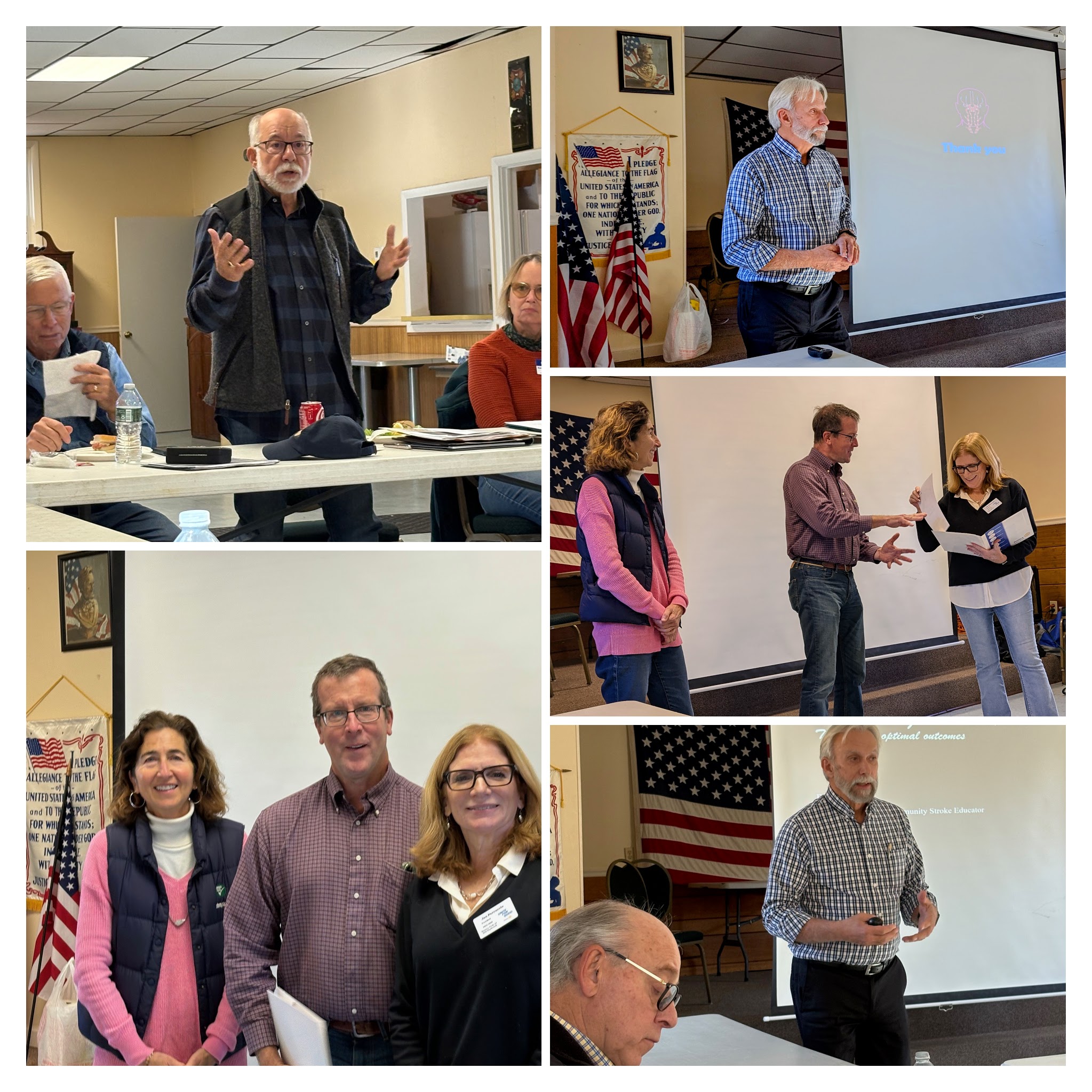
President Jan started the meeting with the induction of Michael V. Millerick. Michael is "gainfully retired" and enjoys woodworking, camping, travel and hopes to return to boating soon. He has recently moved to Old Saybrook from Ridgefield where he lived for 30 years. His wife of 37 years is Carol and they have 2 daughters. After working hard in a corporate finance career, Michael says its time to give back to the community and Rotary is a good way to do that!
A couple of initiatives have taken off:
John Aforismo is leading a Coat Drive. Heather McNeil and Kelsey Christiansen identified a need for warm winter coats, scarves, gloves and knit hats. John spoke with Tara Winch (Community Outreach) and presented to the Board, and came up with the following:
Needs:
30 Warm Coats (Sizes were provided). Gently used coats will also be accepted.
Scarves, Gloves and Knit hats
Process:
- We have developed a card for each coat size as well if it is for a boy, girl, adult male, or female.
- At today’s meeting I presented the process and asked those in attendance if they could pick a card and obtain a coat.
- Now that I know they need scarves, gloves and knit hats – additional opportunities for many more people to get involved.
- I will present this again at the November 19th meeting
- Those who were not in attendance today and wish to participate before next week’s meeting – please e-mail me and I will pick a card for you. I will send you an e-mail with your “selection.”
- Delivery is set for Tuesday December 9th, time to be determine, at OS Social Services Department. At this time, I would ask that a few members please come with me to deliver the items.
- I would like to have all the coats and accessories the weekend for December 6th and 7th. I would be happy to pick them up from you or you
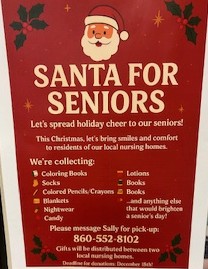
There is another need out there that Joy Fogerty will be spearheading; SANTA FOR SENIORS. There are 2 Nursing Homes in Old Saybrook; Apple and Gladeview that are in need of items for their residents. Many are not seen or may even be forgotten during this time of year and throughout the year. The flyer above outlines needed items: Coloring Books, Colored Pencils/Crayons, Socks, Blankets, Nightwear, Candy, Lotions, Books, and just about anything that will brighten their day. The deadline for donations: December 18th. Joy will be the point person for our club. Any questions – contact Joy.
Joan Winters announced the first Food Drive and posted it on FaceBook. The second Food Drive is scheduled for Dec. 5 from 12-4 at Stop & Shop. Please sign up to help.
Martha Rothchild announced plans for Westbrook Thanksgiving Meal distribution for Nov. 26. The plan is in place and is good to go!
Charlie Renshaw was contacted by Fox Hopyard seeking a commitment for next year's Golf Tournament. Some possible dates have been discussed.
Epply prints are available to club members. See Pete Zucco if you'd like to purchase a print. The prints will also be offered to the general public possibly at our Wine Tasting event.
Speaker: Bradley Fowler, Paramedic and Stroke Educator Middlesex Health
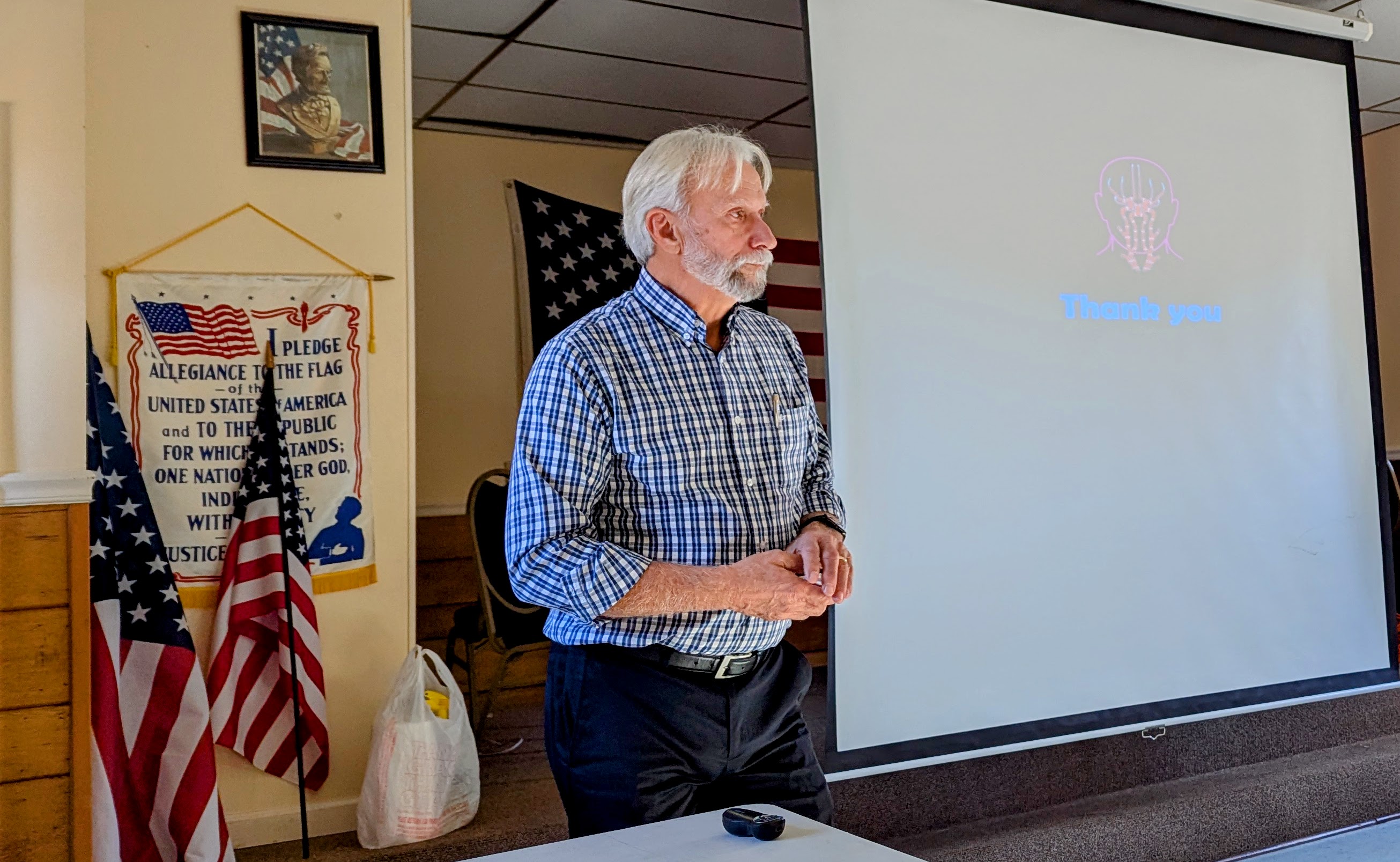
Brad has been a Paramedic for 29 years and a Stroke Educator for 22 years. In 1991 Brad suffered a stroke. Thankfully he made a full recovery with no lingering effects - he was lucky. Brad retired 5 years ago but Middlesex Health asked him to remain as an educator doing presentations and educating the public on this important medical topic. This is a free service from Middlesex Health.
Brad began the presentation with some sobering statistics: There are 795,000 strokes in the US per year resulting in 170,000 deaths. The number of deaths is certainly understated because autopsies that would confirm stroke as the cause are not often done. Strokes are the 3rd leading cause of death in the US. In 2020 over 51 billion dollars was spent on treatment of strokes which have a 25% mortality rate. The rates vary by geography with southern states (stroke belt) having higher mortality rates. Connecticut has the 4th lowest rate in the US. There are many reasons for this including race with blacks suffering a higher rate than whites. Black children suffer a higher rate due to the hereditary condition known as Sickle Cell Anemia in which red blood cells are not round but rather sickle shaped and can cause blockage in arteries.
More statistics, following a stroke:
- 19% will have speech problems
- 30% will have ambulation problems
- 50% will suffer paralysis on one side of their body
- 25% will be dependent on help for daily living activities
- 26% will need care in a nursing facility
- 35% will suffer depression
Stroke is the #1 leading cause of disability for Americans
When a stroke happens, tissue damage from cell death is caused by an interrupted supply of oxygen and nutrients to cells. There are 2 types of strokes: Ischemic caused by blockage of an artery and accounts for 83% of stroke cases and 17% are hemorrhagic (broken artery). Treatment has come a long way in last 20 years. In the past there wasn't much that could be done but today there are effective treatment options but its extremely important to catch it early. The drug Alteplase is a tissue plasminogen activator (tPA) which dissolves blood clots and is used within a certain window of time following a stroke. In addition, clots are retrieved from arteries in the brain by passing a device up through the femoral artery, into the aorta and into the brain via one of the carotid arteries. When a blockage in an artery occurs, there is primary cell death followed by release of toxins and water is absorbed leading to secondary cell death. Cells go into a low energy state - a defense mechanism, but eventually cells, including brain cells die from interrupted blood flow. Time is of the essence when someone suffers a stroke. Every minute counts because cells are dying in real time. Early treatment means more cells, particularly brain cells are saved. Males suffer more strokes than females early in life but because females live longer they account for more total strokes than males. Gender, race, family history, whether or not you have suffered a stroke before, are some of the factors that are considered important when assessing risk. TIA's or Temporary Ischemic Attacks are thought by some to be of minor importance because the term implies its fixable. This is not of the case. The body managed to fight it off but the root cause must be determined to avoid a more severe stroke down the road.
Some modifiable risk factors to help prevent strokes include high blood pressure, irregular heartbeat (especially atrial fibrillation), diabetes, elevated cholesterol (LDL), carotid artery narrowing, alcohol abuse, tobacco consumption, illicit drug use, sedentary lifestyle, obesity and sleep apnea. These things can be treated by medication and lifestyle changes thus reducing risk of stroke. In atrial fibrillation, the heart is not effectively pumping the blood so it stagnates in the atrium and pools which leads to clot formation that can eventually travel and block an artery.
Common signs and symptoms include speech problem and speech cognition, sudden weakness, paralysis or sensory loss, difficulty swallowing, sudden change in vision, loss of coordination on one side of the body, unexplained dizziness, sudden severe headache and altered mental state. A quick assessment can be done if you suspect someone is having a stroke - think F.A.S.T.
Face - 1 side of the face droops
Arms - hold arms up straight ahead - does 1 arm drift down?
Speech - ask to repeat a simple phrase - is the speech different than normal in tone/volume
Time - if any of the above are evidenced call 911 and get help fast
One or more of these symptoms may be present
If you call 911, it's important to get ready for arrival of emergency personnel to avoid delays and save time. If the person is unconscious roll them on their side. If its nighttime when you call 911 turn on the lights so your house is easy to spot, unlock the door for easy entry and secure pets. Be ready to provide information on the victim's medications, their doctor and medical conditions. Provide a history of the event including when you first noticed symptoms. DO NOT GIVE ASPIRIN, as this may make it worse depending on the type of stroke.
Brad took questions following the presentation.